Passion fruit is a tropical fruit that is well known for its peculiar shape, aroma and flavor. The fruit has been used in many types of cocktails, mocktails, pastries, cakes, juices, jams and so on. Do not get misled by the fruit’s shape, a passion fruit contains vitamins and minerals that a body requires in a day. The fruit is edible when it becomes mature, the raw passion fruit contains acids that can hurt the body, so consume the fruit when it becomes mature.
Passion fruit belongs to the family of Passiflora aceae. Even though it is a tropical variety, some varieties can withstand subtropical climates also. The fruit can be seen in almost all parts of the world such as Asia, Europe, Australia and South and North America.
It will be hard to open passion fruit with fingers even if the fruit becomes mature. Use a knife to open a passion fruit. Place the fruit on a board or on top of a table, and slice through the fruit. Make sure not to spill the inside pulp. Once it is cut, take a half and use a spoon to have the pulp. No need to remove the seeds from the fruit.
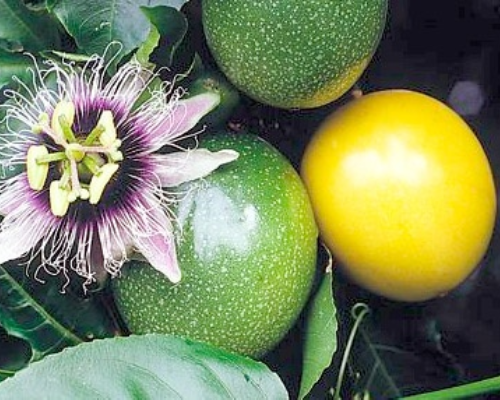
 Passion Fruit (Red, Layer) Plant
 Passion Fruit (Black, Layer) Plant
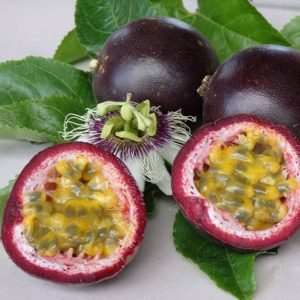
The shape of the fruit is round to oval which has 4cm to 7.5cm long, depending on the variety. The vine produces flowers that grow up to 5-7.5cm long. These flowers later turn into fruits.
The yellow passion fruits are bigger than the other varieties. The purple variety has more aroma than any other variety. The average weight of purple passion fruit is 35 grams and yellow weighs 85 grams. Within the fruit, there will be around 200-250 black or dark-brown seeds which is edible. The taste of the pulp is acidic with a little bit of sweetness.
The taste of the fruit is acidic with a little bit of sweetness. Inside we can see yellowish pulp which has more than 300 seeds. The outer skin is hard and considered to be non-edible by most people. The fruit provides fiber, vitamins, iron, magnesium, calcium and potassium. It gives a low quantity of calories. Passion fruit delivers antioxidants that help to remove harmful elements in our bodies. It also helps the free flow of blood and thus decreases blood pressure.
Reviving the taste of passion fruit makes it a well-known item in including one’s food and drink alternatives. The organic product is rich in supplements, yet in addition gives satisfactory fiber, potassium, calcium, phosphorous and iron. The natural product is seen in numerous beverages and food alternatives like juices, syrups, mixed drinks, mocktails, cakes, jams, curries and other flavorful things.
|| Popular Passion Fruit Drinks You Can’t-miss
https://www.greensofkerala.com/agriculture/popular-passion-fruit-drinks-cocktails-recipes-preparation/
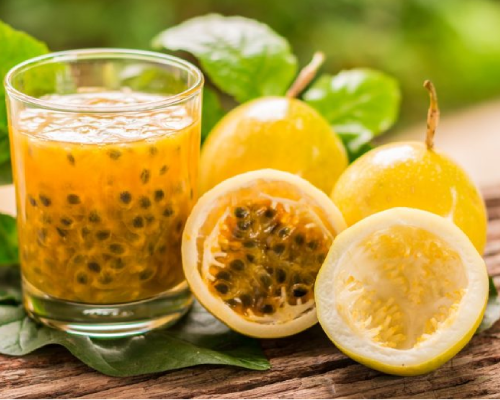
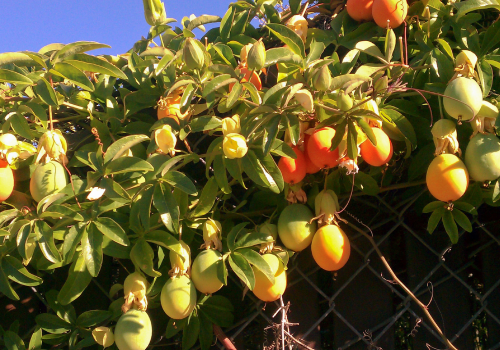
Passion fruit does not need much attention or fertilizers. Either seedlings or stem cuttings are used for passion fruit plants. Stem cuttings will grow faster and bear fruit than seedlings.
It is better to do pre-planting work in the soil before a month. Mix the soil with compost and cow manure. Dig a hole that is 2ft wide, deep and long. One can plant a seedling or stem in the hole and water well the sapling. Watering has to be done frequently, especially when they are young, flowering and bearing fruits. While applying water and fertilizers, make sure they reach up to the root level, not just on stems and leaves.
The fruit has more shelf-life than many other fruits and vegetables. So, it can be easily transported from one region to another without damaging the fruit. Nowadays the fruit is used for juice, squash, jam, concentrate, jelly and pickle. Districts of Kerala such as Idukki, Ernakulam, Thrissur, Malappuram, Kozhikode, Palakkad, Alappuzha and Pathanamthitta are forerunners of passion fruit farming on a large scale.
⚠️ Orders are temporarily paused due to nursery maintenance. We’ll reopen soon!
No account yet?
Create an Account (+91) 9746 999 125
 support@greensofkerala.com
 Pan India Delivery